Tuesday, May 1, 2018

Thomas Sankara: Africa's Real Life Superhero


We encourage aid that aids us in doing away with aid...Welfare and aid policies have only ended up disorganizing us, subjugating us, and robbing us of a sense of responsibility for our own economic, political, and cultural affairs…”  Thomas Sankara


My son was overcome with excitement when I told him that I was taking him to watch the “Black Panther” in 3D. It’s a movie based on a superhero, who rules a country called Wakanda (don’t look at a map, it does not exist).  As I sat there watching the movie with my son and spending $20 on just the popcorn and soda (movie theaters are now so expensive, they should consider having financial aid offices…just saying), I remembered one of my own superheroes, who unlike T’Challa, lived amongst us!!  His name was Thomas Sankara and was the president of Burkina Faso from 1983-1987.

Sankara ruled a country that unlike Wakanda did not possess Vibranium! It was a country short on natural and human resources, dependent on food aid, dealing with harsh weather conditions and steeped in corruption. Sankara took over and was determined to uplift his people, his nation and his continent. So he started with himself and his cabinet, he cut his own salary to $450 per month. Now that’s superhero right there, to have access to all your nation’s wealth, however small it is, and refuse to put it into your own bank account. No one in his government could fly first class anymore, Sankara said, “whether you are in first class or economy, everyone gets there at the same time!!” and all government expensive cars were to be sold and only the cheapest cars were to be driven by government officials. Bottom-line, everyone in power had to sacrifice and lead from the top. 


The limited resources were used to empower the farmers to free the country from food aid and increase agricultural production to improve the economy of the country.  Have you been to Burkina Faso? If you have not been please google it (unlike Wakanda, it exists). It has low and erratic rain fall, and limited, poor arable land and yet during Sankara’s presidency (in 4 short years) he was able to take his country and make it food independent. Food production went up and eventually Burkina Faso became an exporter of agriculture products!! So how did he do it? 


Besides, not sitting in his office all the time under air conditioning (he actually refused to have AC in his office) and not flying to Europe and Asia for vacation, he went out amongst his people and tried to first harness the human resources within his own nation. Sankara, was a hands-on president that got out there and worked on projects, whether it was laying down rail-roads, or planting trees, he was there. When people saw that, they came out and by now the whole nation was building their own country. 

Thomas Sankara, did not need to bring experts from Washington, London or Paris to tell him what was good for Burkina Faso, when the experts were right there in Ouahigouya, Ougadougou and Po. He did not have to attend conferences half-way around the world and collect per diem to know that stealing from your own country was wrong.  

He understood the power of unity within an African Union (AU) which would be independent and unify within itself to empower its citizen and continent, an AU that would move away from a dependency mentality that enriches a few and subjugates the rest. I wonder what Sankara would say that a country that has no resources (China) build the new AU building for a continent that has all the resources! Perhaps he would say something that would get him killed!!       


And that’s what happened to my superhero, he was killed in 1987, by a coup orchestrated locally, regionally and internationally.  The true nature of his super powers was his actions, which like Vibranium, if applied can transform Africa, or for that matter any region or any country into a fully-functionally, strong, healthy and rich society.  The ideas of Sankara sits ideally, to be emulated by the wise leaders yet to come.

As I held my son’s hand on our way out of the theater, I told him to remind me to tell him about my superhero named Sankara… 

Saturday, March 25, 2017

There Was Once a Lake Here; Journey Through the Water-Ways of Iran!


Every summer my father planned a trip that took us around Iran. That meant over the years we got to visit more that 75% of the land mass of the country. Our journey started from the southwest city of Ahvaz and took us all over, from west to east, south to north. We crisscrossed the mountains, the rivers, the greenery and the dry landmass that represented the amazing and eclectic Iranian topography.  From the Zagros to the Alborz Mountains, from Karoon to Aras River, from Kavir to the Lut desert, we climbed it, swam in it and drove through it. One of my most memorable part of these voyages through Iran (though not always my favorite!) was my dad stopping the car in the middle of nowhere and giving us a bath using the many small waterfalls that flowed out of the mountains, all I remember is how much I hated the cold water and how clean and refreshed I felt after the bath. When we found a river, we would stop by and eat our breakfast or lunch next to it, enjoying the clean, clear water and the soothing sound of water flowing...sitting under the tree that provided us the shelter.


On one of the trips we went to an amazing body of water located in north western Iran called Lake Urumiyeh. As soon as my dad had parked the car we ran out towards the lake. As we got closer we felt the heaviness of the air. We got to the edge which was full of green algae, with a bit of encouragement and pushing from my older siblings, I rushed into the water. As soon as I plunged in, I felt a strong burning sensation in my eyes, no one told me that lake Urumiyeh was a salt lake. My eyes were burning and I decided to come out quickly and try to fix it. A local guy standing there seeing my agony approached my parents and gave them a cucumber and told them to put it in my eyes and that would sooth my discomfort. That day I was introduced to a water system, that held a prominent place not only in Iran and the middle east but globally too. Lake Urumiyeh was the biggest salt lake in the Middle East and the sixth largest in the world.
Lake Urumiyeh 1980s

Tragically, over the past few years, Lake Urumiyeh along with the many water ways of Iran are either in decline or dying. Though climate change can be blamed for some of the declining water levels and river beds in Iran, the main culprit is the mismanagement of water. There are many experts both in Iran and from outside that are warning about the water crisis and the long-term consequences that could lead Iran to become a “water-insecure” nation.
Lake Urumiyeh today

A serious commitment to addressing Iran’s water crisis by the Iranian authorities and utilizing both domestic and international expertise, will be go a long way to prioritize water on the national dialogue and policy.


For thousands of years the people of Iran used engineering ingenuity to manage water to be able to live and thrive in an otherwise harsh environment. This ingenuity is still there and must be allowed to express itself to solve this crisis and revive Iran’s water system.

The threatened River Karoon 

I think of my days as we crossed the bridge over the once mighty River Karoon and with that image in my mind recall the beautiful poem of the late Iranian poet, Sohrab Sepheri who writes…


Let's not muddy the water.
Imagine that close by a dove
is drinking from it,
or in a distant grove a finch
is washing its wings in it,
or in some village it fills a storage jar.
Let's not muddy the water.

Perhaps this flowing stream runs
by the foot of a poplar tree
and eases some heart's grief.
A dervish, perhaps,
has moistened his crust in it.
A young woman stood on its bank---
the water doubled her beauty.
Let's not muddy the water....

Tuesday, May 10, 2016

Once Upon a Time in the Middle East!


Mr. Ameri greeted my parents with his loud voice and distinct accent as he entered our house with his wife and children. Mr. Ameri and his family visited us at least once a week. In addition to being our next door neighbor, their house did not have a phone line, the wire ended at our house and the phone company had yet to extend the line to theirs! So every week, the Ameris would walk over to our home and call their daughter who studied in the state of Oklahoma in the United States. The calls usually took place early morning and since the connection wasn’t very good, Mr. Ameri who already had a loud voice, had to speak even louder to ensure his daughter in America could hear him well. Mr. Ameri, an Arab-speaking Iranian, happened to be the wealthiest man in our neighborhood, his wife was one the most elegant woman I have ever met, her beautiful jewelry dazzled, and the fragrance of her perfume filled the air like freshly cut roses!
 
 
Our Arab neighbors were just one part of the diversity of our neighborhood. On the other side of our house, were the Hakoopians, who were Armenians and whose kids we spend lots of hours playing with. Scattered all over our neighborhood were families from nearby regional cities of Abadan, Masjed-Sulayman,  Khoramshahr and other parts of Iran, from Tehran, Esfahan, Mahabad, Tabriz, Arak, Shiraz. Then there were our Americans and European neighbors who kept to themselves but were nevertheless part of our neighborhood's landscape . And amongst the movement of people in and around our house were the Lor laborers and the Arab watchmen.  

The ethnicity, cultures and belief systems represented in our little piece of the Middle East, resembled the diversity that you might find in neighborhoods in United States and phone-lines or not, would have been the envy for many around the world.

Maybe one day all the leaders and all the peoples in the Middle East from Tehran to Baghdad, Damascus to Beirut and Amman to Riyadh will try to emulate my neighborhood and appreciate its beauty and understand the true benefit of its diversity. Until that day, I will sit in Washington, DC and think about it like a story that starts with, “Once Upon a Time…”     


Monday, January 18, 2016

An Italian Captain, Inter Milan, and the Afghan Football Club that Could!


I sat in the dining hall of the Italian military unit enjoying my pasta, chicken and a bottle of Italian lemonade. The Italian dinning hall on the Shindand Airbase was run by a dedicated group of staff who ensured that their soldiers were fed the best home-cooked meal thousands of miles from home. I usually stopped at the Italian dinning facility when i met with Captain Simone, the civilian-military team leader and his staff. On this day, I sat across Captain Simone, as we talked about a possible project that we had discussed since the first day we met. The project focused on youth and football (soccer) development. Simone agreed that such a project would be useful. We also agreed that any project to do with strengthening sports in Shindand District, would help the youth, from the feeling of belonging to a group (to counter insurgent groups) to cultivating good, healthy habits, to building organizational and leadership skills.  The only problem for Simone was to convince his commanders that the project would fulfill the goals of their mission! I thought that any project that would strengthen the Afghan youth and give them an avenue to express themselves positively, was a good project. Unfortunately, not everyone saw it that way.

Simone, went to work and after months of back and forth, begging, lobbying, pushing and perhaps crying he was able to get a whopping one thousand Euros! I looked at Simone and Simone looked at me, and he said, “can you get someone to do this project for 1000 Euros!” I said, “Sure!” and then thinking to myself, “how the hell am I going to get someone to fix a football ground in this country for less than 10,000 Dollars?!”

I immediately called a couple of contractors and asked if they would do this project. We needed the contractors to roll and fix the pitch, put official size goals with nets, and build two benches on either side of the field! Both contractors agreed to do it, with lots of enthusiasm, and promised they would do the best, most professional job ever… Then I told them how much money they would get paid for it and after, there was a long silence, and then they said they needed to check on something and get back to me!!! That was their way of saying No!


Finally, I called Karim, a friend of mine and Atiq, the captain of Maiwand Football Club, the club which would use the football pitch. I gave them the good news and the bad news that the Italians agreed to help the team but could only come up with 1000 Euros. After taking in the news and asking over and over again about the actual amount, Karim and Atiq said they would do it! I knew 1000 Euros could go a long way in a place where the price of bread was .05 cents, but after a decade of hyper-priced projects where things costing $1.00 were quoted as high as $100, no one would agree to do anything for 1000 Euros!


Karim, Atiq, and others from Maiwand FC, got to work and slowly, and with whatever equipment they could get their hands on, including a tractor, they shaped a patch of wilderness into a football ground. Every evening I would come by to inspect their progress and I saw about 20-25 young men working on flattening the bumps on the field, some mixing the cement and some picking up the stones and cleaning the field.  I would report back to Simone about the progress of the field and grab some Italian food in the process!  


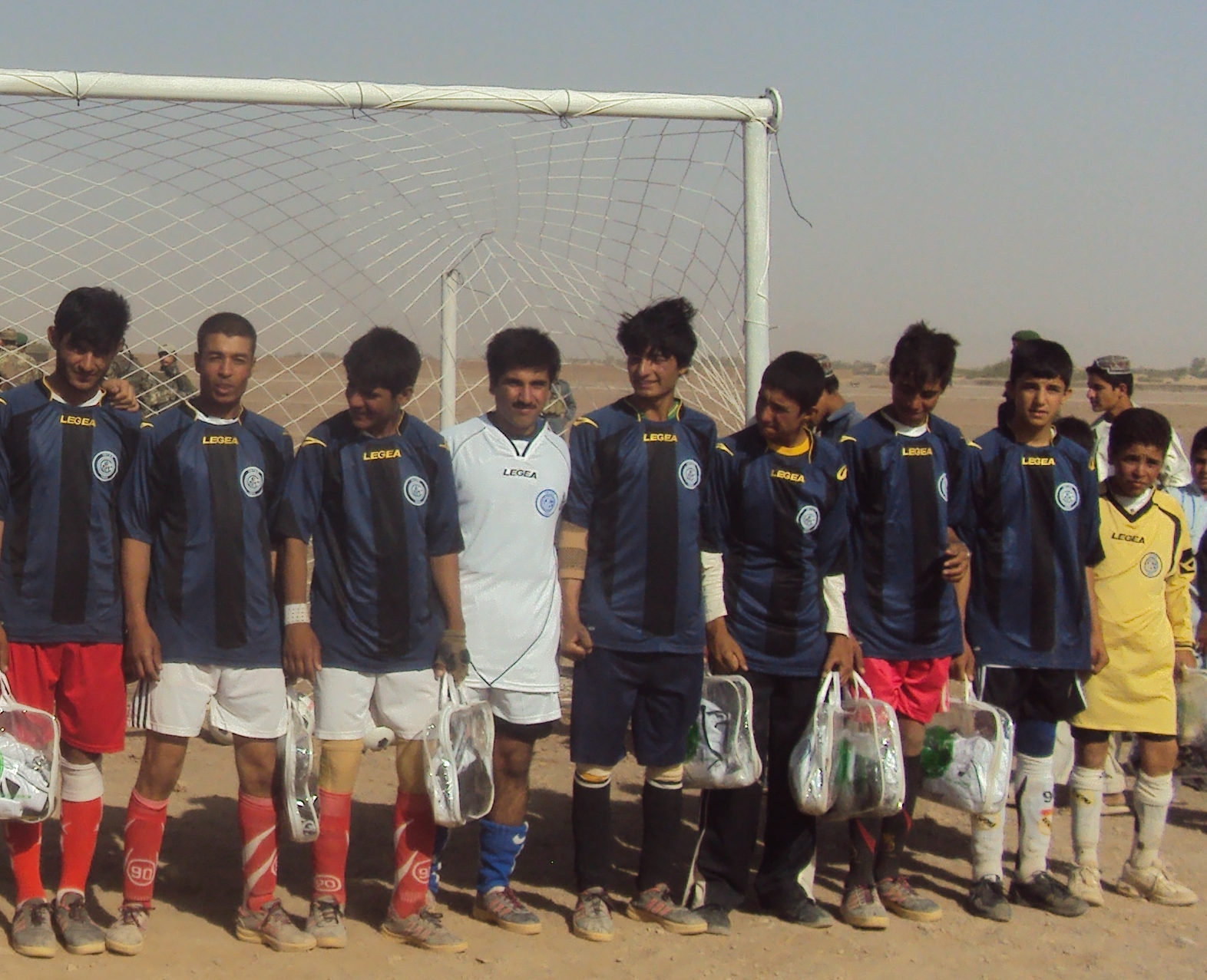
Then one day something incredible happened…Simone called me in and said that he has some good news to share! When you are in Afghanistan, good news is something you don’t hear much of! He said that the great Italian football club F.C. Internazionale Milano, aka Inter Milan have agreed to provide the uniform for Maiwand FC….What? I asked, thinking maybe something is gone wrong with my hearing (I am getting old!). He said, that he wrote a letter to Carlo De Medici’s office, the president of Inter Milan asking if his club would donate uniforms for this projects and they agreed and the official uniforms are already on their way to Shindand District!!!


So finally the ground in Shindand was ready and the uniforms from Italy had arrived. On inauguration day, as a strong wind blew dust around, Maiwand FC lined up…local dignitaries, Captain Simone, the Italian military and spectators gathered around on the field. After a short speech by the Italian Commander, the uniforms were handed out and the faces of the 22 young men lit up as they were told about the gift from Inter Milan and the authenticity of their uniforms.


Weeks and months after that, the 1000 Euro field, became a haven for young men, who came by to play football or cheer on their team. Maiwand FC hosted many games there and showed off both the field they had build and the beautiful uniforms they had received. And at least for a while they became the kings of Shindand, thanks to their resourcefulness, the support of an Italian captain and the generosity of a millionaire in Milan!

Saturday, November 21, 2015

The Syrians at Our Thanksgiving Table!

"Give me your tired, your poor,
Your huddled masses yearning to breathe free,
The wretched refuse of your teeming shore.
Send these, the homeless, tempest-tossed to me,
I lift my lamp beside the golden door!"

Quote from Emma Lazarus used for pedestal on the Statue of Liberty

One of my favorite American holidays is Thanksgiving. It’s a day where family and friends all over America gather and share a meal together and in their own way express their gratitude for whatever they are thankful for. Some are thankful for democracy and freedom, some are thankful for having food on their table and some are thankful for good health.

My first Thanksgiving was spend at the house of an American family who had at her table a hodgepodge of people of different races and ethnicity, she was Italian, her husband was Dutch-Indonesian, there was a German, English, Russian an African American, a native American and of course us, Iranians! Bottom-line, we were all Americans gathered around one single table and sharing a meal. One of the things I remember before we partook of our food, was that we went around the room and mentioned one thing we were thankful about and most were thankful for being around that table with their friends and loved ones. I think I was just thankful to have survived my first year in America! Just like the first settlers who came to the United States fleeing persecution and yearning freedom.

Every Thanksgiving I am reminded of that first Thanksgiving where I was introduced to the diversity of America, where America’s unique make up and identity was represented around that table. We were all from different parts of the world and somehow through destiny, through the uncontrollable historical and personal events, we found ourselves becoming citizens of one nation. With all its greatness and shortcomings, America is a place where people from far and near and from all four corners come to seek refuge. America’s strength lies in its ability to open its arms to people who seek a better life and a better future. It is this openness that makes America the great country it is. Its diversity energizes its growth and fuels its ever-advancing progress in creativity and innovation.

As we approach this year’s Thanksgiving my thoughts are with thousands of refugees who are struggling to survive the harsh realities of a life without a country and without a future. There are many amongst us that don't want the Syrians in America. Their opposition not to allow them in is based on fear perhaps based on their forgotten family history that they too came to the US from another part of the world, either fleeing war or economic deprivation.  

They believe that amongst the thousands of Syrian refugees that might come to the US there might be some who will commit act of terrorism on US soil! 

Refugees who come to the US go through special security screening, people don’t just get up and buy a plane ticket and get here. Syrians will go through the same process. Most of them are families, mothers, fathers, children, no place to go…How can we as a nation think of them as terrorist and keep them from our shores? Were all the previous groups that came to our shores seeking refuge… perfect? Let’s not open our nation’s can of worm!!!  

As Americans we should step up to the plate and lead all nations in accepting the most number of Syrian refugees! Because where else would a refugee seek refuge other than a nation founded by refugees? 

The Syrians are culturally diverse and culturally wealthy people who are descendants of an ancient civilization. How can a people who have kept cities bustling for thousands of years be a liability to a young nation such as ours! How can a people with great cuisine, a great sense of style and sophistication and a thirst for knowledge and education not be allowed to find safety and a place to strive in America?  

We are a nation of abundance not only in material wealth and resources but more importantly in compassion.


So this year at our Thanksgiving meal let’s remember the thousands of Syrians fleeing war and violence and pray that by next year we will have a place for them at our Thanksgiving table.

Sunday, August 9, 2015

Afghan Government and its Population Must Create a Peace Partnership!

Karim Afghan was one of the first people I met when I arrived in Shindand District in 2009. He was in his late 30s, an Afghan nationalist, and a community leader. He wrote and recited poetry in both Pashto and Dari and had a great sense of humor. Karim had a music shop in Qanati market and hustled day and night to provide for his large family. As the USAID Representative, I relied much on Karim’s contacts and smarts when doing my work. He was one of main reasons for the successful execution of our programs in Shindand.

One day I asked him, “Karim, why doesn’t the violence in Shindand and Afghanistan end?” He replied, “Because you foreigners don’t want to end it!” He went on to say that the usual suspects, Pakistan, India, Iran, US, the Russians, the Jihadists, use Afghanistan to wage their wars against each other. He said the worst part is not only that the Afghans suffer the brunt of this violence in terms of loss of life but it also fragments and divides the population. These scuffles and the games played by various powers push individuals and groups to become agents of these governments and do their bidding. It becomes a daily game of survivals for the ordinary Afghan. Karim went to on to say, throw in a weak Afghan government, which is corrupt, lacking resources and politicians who are incapable and at times not interested to unify their people, and that is why this cycle of violence, instability and war continues. He ended by saying, “Let’s forget about these things, lets drink some tea and listen to Naghma (Afghan singer)!”

What Karim told me that day is believed by many Afghans and non-Afghans. Afghanistan is located at the cross-roads of civilizations. Its a place where competing powers come to settle their scores. It was England vs. Russia, US vs. USSR, Pakistan vs. India, US vs. Al-Qaida and so on. Throw in the Afghan struggle to run its own affairs, create a modern state with its own national identity and a society in the era of globalization, and you can appreciate why peace, security and stability continues to elude this ancient land.


So what is the solution? Today, as the violence continues, the Afghan government has tried to engage the Taliban and their main sponsor Pakistan in peace talks. Though that’s a start, the fact is, those talks have not yielded any concrete results. The senseless killing continues.

To bring peace, the Afghan government must make its own population, its main partners in the peace process. Afghan traditional local peace councils must be re-established from the Kabul-level to the village-level. Those who are part of this violence and its enablers, both as Talibs or other groups in each community must be invited to lay down their arms and brought back into the fold. And unlike other attempts made previously, those who come back must see their acceptance back by their community as a reward. In other words their bad behavior is forgiven, they are now again a full member of the community and should in no way be rewarded by been given land or any other resources.

It’s time the Afghan government turned to its own population to bring peace to the land. Pakistan or any country will not give peace to Afghanistan, it’s only the Afghan government along with its population that can demand it and bring it. This action if taken by the leaders of Afghanistan will strengthen nationalism and unity and create an avenue for those gone wayward to return to their communities. Prioritizing peace will ultimately and in the long run bring all the business and development needed to pull Afghanistan out of the poverty that ails most of its population.


For those of you, who want to know what happened to Karim Afghan. Karim was killed a couple of years ago by the Taliban while on his way to his shop. Let’s work for peace in Afghanistan for Karim Afghan’s sake and the millions that have been killed senselessly during the past decades.

Wednesday, May 20, 2015

Amitabh Bachchan: Our Hero for All Times!


It was January of 1979, I was 11 and our Air India flight from Karachi was about to land in Bombay (now named Mumbai) International Airport. Our trip had taken us from Tehran to Karachi and after two days in Karachi we made it to Bombay. After we landed there, we were driven to Poona (Pune) and onto to Panchgani, a hill station in the western State of Maharashtra where my sister, my brother, I would attend, New Era High School, an international boarding school.

One day we were in Ahvaz, in the comfort of all that was familiar to us…our city, our home, our language, our food and above all, our family and friends…in what seemed to be, a blink of an eye, we were taken away from it and put in India. Fortunately for us, we went to a boarding school where most students were our age and came from all over the world, from Iran to Canada, United States to Ethiopia, and Somalia to Australia. Exposure to this rich mixture of diverse cultures at a young age developed within me the ability to mingle with all peoples and see diversity as a strength and looked for it rather than avoid it! Give me a work force from 10 countries, 50 cultures/tribes and a table with chicken briyani, Awaze tibs, chelo-kabob, goat curry, and Tuo Zaafi with bito soup and Guinea Fowl meat on it and I am as happy and productive as can be!

That was the campus of New Era High School….But outside of that, there was India. India with its populations of 700 million (1979)! The wealth of Indian culture was immense, this wealth was a direct reflection of its diverse population. Different languages, nationalities, tribes, religions, food, music and geography, all within this huge land mass. For me as a kid, nothing and no one brought these difference into one arena as did Bollywood and its incomparable hero, Amitabh Bachchan.


Amitabh Bachchan became our hero. I remember the first movie I saw with Amitabh in it. It was in the city of Sholapur and the name of the movie was “Suhaag”. The movie was “house-full”, no seats available! A few minutes into the movie, Amitabh finally appears on the screen, with him drinking a bottle of whisky and the theater erupted…as if he was standing on the stage in person!! People started to throw coins towards the screen! The best a Hollywood megastar could do was get a clap or two!! Whether you were an 11 year old kid like me or a 50 year woman sitting behind us, we were all taken over and mesmerized by Amitabh baritone voice, acting, singing and dancing. And when the movie came to an end, it was as if you woke up from a dream! It was an amazing feeling. The songs from the movies were all around us, whether walking in the bazaar or in school. We would try to imitate Amitabh’s dance moves and the term “hero” and “Amitabh/Amit” were interchangeable in our lingo…Ultimately, Amitabh’s heroism on the screen infused some of us with the wealth of Indian music, and our love for it.
 
In 1984 when my siblings and I left India for the United States, we brought with us a piece of India, which was our love for Amitabh Bachchan, Bollywood and its music which had sustained our childish spirit during the five years we lived in India.

Till today, when the times are tough or when my days are not going well, one of the avenues I turn to for spiritual upliftment and motivation is an old Amitabh song and dance number! So it was in 1989, my first semester at Holyoke Community College, when taking one of my first international affairs classes. It was mid-terms and we had to write a paper. Let’s just say my professor did not like my paper, she came quite hard on me, and told me “what the hell is this?” She used the word “hell’ because she was too polite to use the “F” word! I took the paper came home and just fell on the couch, depressed and looking at the ceiling. Not knowing how to get myself up and motivated after that very negative encounter with my professor!  I simply got up and took a cassette and put it in the video player and turned to Amitabh, the hero of my childhood to save the day and put some motivation back into my being!! It just took a song from the movie “Mr. Natwarlal” where Amitabh Bachchan and Rekha sing and dance to the song, “Oonchi Oonchi Baaton Se”! A week later I stood in my professor’s office and she turned to me and said, “This is what I was looking for, much better…good job”.

If I told her what was behind the better performance, she would have never believed me!

Thursday, May 14, 2015

The Date Palm at the Entrance!


“Where are you going?” asked Azanpoka, “I am going to Bolgatanga” I replied. I had not walked more than 20 meters from Mr. Tony’s house, where I lived, and Azanpoka was the third person asking me where I was going!! Such was the culture in Namoo, a small village, located in Bongo District, on the Ghanaian border with Burkina Faso. Asking where you were going was a way for the community to make sure they knew where you were at all times and if you did not come back they would know where to start looking for you. Since I was a visitor they felt an extra sense of responsibility for my safety!

Having cleared five-levels of Namoo security! I got to the roadside waiting for the taxi. The taxi having crossed from the village of Yelwongo on the Burkina Faso side into Ghana, had already pick up 5 passengers. The taxi driver stopped, having recognized me as Anamoo (local name given to me by the Chief of Namoo), he looked around in his taxi and asked the passengers to shift around and make room! I was able to fit myself inside this beat up Nissan. I got very close to the passengers, we all got too close… but hey as my dad used to say, “Cheltaa Darvish tooyeh yek Poosteh Gerdoo Zendegi Mikardand!” “40 Dervishes lived in a walnut shell!” For those who are trying to understand what does 40 dervishes in a walnut shell have to do with 6 passengers in a beat up taxi, basically it means that if we live simple like a dervish, then there is always room for everyone….OK…never mind!

So the taxi started to move. Bolgatanga, the regional capital of the Upper East Region in the north most part of Ghana, was about a 45 minutes ride from Namoo. As we passed by the village of Sambolgu towards Zoko, I saw a beautiful palm tree, and for a second I remembered the palm trees filled with dates that use to decorate Ahvaz, the city of my birth, in southwest Iran. And at that moment I craved those sweet dates we use to eat with no end in sight!!! If you put a million dates in front of us, we would finish them all!!

We got to Bolgatanga and were dropped off at the the Namoo/Bongo transport yard. I got out of the taxi..a bit soar, a bit dusty and a bit nostalgic! I started to walk towards the town center, where I would usually stop by the Traveler’s Inn, a small restaurant/shop. This is where I would get a cold Coke to drink, a luxury considering that Namoo at the time did not have electricity and therefore no cold drinks to enjoy! And with temperatures well above 100, anything cold was heaven send.  As I sat there with a bottle in my hand, the thought of the date palms of Ahvaz lingered in my mind. I looked around and then suddenly out of nowhere appeared a woman with a big round tray on her head!

“Sir, do you want to buy?” she said as she brought down the tray and long behold there was a tray full of dates!!! I looked at the woman and asked, “Are these dates?” asking for a second opinion in case my mind was playing tricks on me or I was hallucinating…maybe someone had put something in my bottle of Coke! Out of nowhere had appeared a woman with a tray of dates…”Where did you get these dates?” I inquired and she pointed to the sky and said, “by Bawku side”. I later found out the dates were from Niger. But at that moment I was so excited I did not care where they had come from. I bought everything or almost everything this woman had on her tray and made her a very happy person, she did well that day!


In matter of minutes I ate most of the dates, but I did control myself enough to save a couple of pieces for Mr. Tony. I returned to Namoo that evening and sat with Mr. Tony eating our dinner of Tuo Zaafi (TZ) with Bito Soup and Guinea Fowl meat. After dinner I introduced him to his first date! He ate it and liked it. After a few days when the excitement of eating the miraculous dates had died down and I had gotten back to my senses! I remembered that I had saved some of the seeds and brought them back from Bolgatanga. I went to Mr. Tony and said why don’t we plant these seeds and see if they will grow, he readily agreed. Mr. Tony was desertification’s worst nightmare! He would plant any seedling or seed he could get his hands on!! So he called Ibrahim and Abdulai, two of the kids in our house to come and dig a small hole in the ground and we brought the seeds and planted them. From that day we all kept a close eye on the spot that perchance we could get a sighting of sprouting vegetation, after weeks of not seeing any growth we stopped looking.

Then the rainy season started, when after about 7 months of no rain, windy weather, and extreme heat, the brown, parched earth was revived and born again. One evening, a few weeks into the rainy season, I heard a bit of commotion, and soon after I heard a knock at my door, it was Ibrahim, who said, “Mr. Anamoo come on, come on and see”! So I followed Ibrahim to the front of the house where he and the rest of the kids had gathered looking at and pointing to the ground! I looked down and there out of the ground were two baby leaves that had shot out from where the date seeds had been planted! We again continued to keep an eye on this small seedling. The dry season came around and Mr. Tony made sure the baby plants were getting their fair share of water. Soon after I left Namoo and Ghana and returned to the United States, leaving behind a home, a family, and a village which was my community for two years and had contributed greatly to who I had become. That was November of 2000.
 
Ten years later I was back to Ghana and made my way back to Namoo to visit Mr. Tony.  The next morning after we arrived, he took me to the front of the house and pointed me to a tree and said, “do you remember the date seeds we planted? Here it is! And there stood in front of me a small palm tree that looked like it had struggled to make it! The seeds that had been planted all those years ago had grown to a youthful date-palm!

Five years later, again I am back to Namoo and our palm date has grown into adulthood! She stands next to the entrance of Mr. Tony’s house as if to welcome the visitors. We found out that the tree is a female and needs a male next to it to produce dates. As the saga continues, we are looking for a husband to be planted next to her! One day she will bare dates for all to enjoy, the same enjoyment I experienced, on that miraculous day in Bolgatanga!  

Thursday, April 23, 2015

The Armenian Genocide and Humanity's Conciousness!

 
“Accordingly, I have placed my death-head formation in readiness – for the present only in the East – with orders to them to send to death mercilessly and without compassion, men, women, and children of Polish derivation and language. Only thus shall we gain the living space (Lebensraum) which we need. Who, after all, speaks today of the annihilation of the Armenians?” Hitler August, 1939
We flung the door wide open and ran outside into the hot and humid Ahvaz summer day. It was time for my sister, brother and I to meet up with the rest of the kids of our neighborhood, a neighborhood in what today would be termed as diverse. We spend the late afternoon to late evening playing our local games, one of the favorite kids were the Armenians, Albrik and Mari Hakoopian. Their uncle Alan, who was older would often teach us new games to play and coach the older kids on new bike tricks. These early play-dates with my Armenian neighbors, would, as I grew up, expose me to the fascinating and at times dark but ultimately triumphant history of Armenians as a people.    
As I left Iran and eventually made it to the US, I got to know more Armenians, who shared with me their family history. It seemed each family, though always successful in their adoptive country, had walked a painful path to get there. Today’s Armenians are scattered everywhere, the main reason for which is the genocide of 1915, carried out by the Ottoman Turks. The total killed was around 1.5 million.

What makes the Armenian Genocide, important historically, is that 100 years after it was carried out, the international community, continues to debate whether it was a genocide or not!! The Armenians have proven themselves, as survivors and strivers. This commemoration for the Armenians, though extremely painful, is also about their survival as a community.  Now all is needed, is for the rest of us and our collective consciousness as humanity to once and for all give the respect to those who made the ultimate sacrifice, and recognize this dark chapter as a Genocide.     


Saturday, February 14, 2015

The Good Afghan: Race, Ethnicity and Diversity in Foreign Service!


Bill stood up and said, “we are now going to have a session on Pashtun cultural norms!” And now Bill, our trainer, started to tell us, a number of USAID field program officers working in western Afghanistan, how the Pashtuns behave! Bill, was a former military personnel who, after coming back to the US, had hung up his boots, came back to Afghanistan, and was hired as an Afghan expert! The problem with him speaking about the Pashtun culture was that, in our group of trainees, we had five Pashtuns, who were more than capable of presenting a view of their own culture. They worked for USAID, they were all educated and the cream of the crop in their respective field. But still it was Bill, who perhaps lacking a bit of "situational awareness", stood up and gave us a superficial understanding of a very diverse and complex culture. During his presentation, he never alluded or asked the opinion of the real, live, Pashtuns who sat with us. Can you imagine if Jumah Khan, from Farah, Afghanistan, flew to Mississippi and told Bill and his family about the American culture?!!! This example underlines one of the fundamental problems with foreign aid, development and diplomacy, where local expertise are often ignored. Race and ethnicity determines who is an expert and who is not, who should lead and who should not, who should be trusted and who should not.  

If there is a “local” expert hired, he/she can’t “act” too local! If your name is Mohammad, you better change in it to “Mo” because the Country Director who is from Iowa can’t pronounce the world’s most common name! The local expert is only considered an expert if he or she can push the goals and the agenda of the donor. If you show or care too much in finding solutions to the problem of the local communities then expect to be sidelined!! I know people, in this case Americans, who changed their “ethnic” names because they were afraid that there would bias against them. They worked for agencies, who go around the world and tell people about the importance of diversity, yet it has created a system that does not allow room for the “other”!  This is not 1492, when Christopher Columbus met the “Red Indians” this is happening in 2015, when Barak Hussein Obama is in the White House!

In 2009, before flying out to Afghanistan, we were given a series of training to prepare us for our work there. Our main trainer was a retired US Diplomat, another “expert” on Afghanistan. The last slide that he showed us before sending us to improve the lives of Afghans, was something that still shocks me!!! The slide had on it, the image of an old American family, riding a horse-pulled wagon, surrounded by the US army, and in the horizon were the Native Indian horsemen with their spears drawn out coming to attack the family!! Our diplomat and “Afghan expert”, ended by saying, “this is how you will feel when in Afghanistan!” We, the USAID, State Department folks were the good guys, whose lives were being protected by the US military against the savages, the Afghans. If he was trying to show his cultural “sensitivity” he did not do a good job. His last slide is an example of how the local population and the “other” is looked upon! To be feared, subdued and civilized, and shaped like us, whatever that is!
 

Hopefully those who are hired to work in the Foreign Service and foreign aid will be hired based on their skill sets, their mutual respect and understanding of their own culture and the local culture, and most importantly to truly work for a world that people's diversity is valued not feared! Until that day more resources will be wasted and the voices of the real “experts” silenced!    


Wednesday, February 4, 2015

Shindand District: Working with Women in Rural Afghanistan!


Rahimah stood up and started to speak about the needs of the women in her community. Her head looked straight up, her voice was loud and clear. This was my first time meeting with women in Afghanistan. Rahimah belonged to a women’s group located in Shindand Town, whose aim was to organize women and provide them with literacy classes and vocational training.

The gender issue is one of the most sensitive topic to address in Afghanistan, but it gets even more difficult when you are working in the rural area. Steeped in traditional, cultural and local interpretation of Islam, women are not to be seen or heard from, their roles are to be played out in their own space, behind the walls of their homes. They are to be seen by their husband, brothers, and only certain members of their male family members. A friend of mine from Shindand told me that a woman’s place is either in her house or in her grave! It was against this background that I attempted to engage women in my work.  

One thing I learned was that though all of the communities within the district were traditional in the view of gender equity, their level of conservatism differed. The other issue was that, because  of the violence in the district, many families had lost their male relatives. These families now depended on their extended family (usually their husband's family) to take care of them. Unfortunately the extended family in most cases were poor and could not support the extra burden.  Because of their economic burden, communities were looking for alternative ways to support the now women-headed families. They were open in participating in women-focused activities. The other factor in Shindand was that many during the past three decades had left Shindand and had lived in big cities of Iran and Pakistan and had been exposed to urban life where women played an active role outside the home and girls went to school. Finally, many Shindandis were part of the Afghan military (Shindand Airbase is the second biggest airfield in Afghanistan) and got their training during the Afghanistan Communist government’s aggressive effort to educate women in rural areas. These former military personnel had been exposed to the topic of women empowerment and some had interacted with women military personnel. Taking all these factors into consideration, and despite the conservative cultural and religious belief, there was a critical mass of people who would support women-centric programming. They needed some entity or someone to facilitate programming according to Afghan rural cultural realities. The most important condition the people of Shindand asked for was, no military nor any foreign men (especially soldiers) should be allowed around the women participating in the programs. They said the mere presence of this group would jeopardize the project.


Unfortunately, there were those in the Coalition Forces and civilian sector who believed that if, you were paying for a project or giving resources to it, you had the right to go and see it. They also thought it would make great photos for folks back home in the US, UK or Italy to see. And ultimately believed that through these photos, they would understand how much their military or their government was doing to advance the cause of the downtrodden women of Afghanistan!!! Basically, they were saying we will help you but I need you to shake my hand and take photos!

The Wrong Way and the Right Way
My phone rang and it was Farzana, who ran a small organization, focused on young women. She sounded a bit frantic, and I asked her what was going on? She said basically, one of the American military units had shown up, unannounced, and brought them sewing machines!! Though she was thankful for the sewing machines, Farzana said, she could no longer work in her office, because the presence of American military units being seen around her office with male soldiers coming into her organization’s compound (usually to escort the female American soldiers) made it impossible to continue her work and she had to close down at least for a few months. This military unit thought it was doing the women there a favor by providing them sewing machines, but in reality all they did was to undermine the efforts of Farzana and her group. What the unit needed to do was ask around and find out if their action was appropriate! This happened in 2011, almost ten years after operations in Afghanistan had begun, I am sure someone had trained these soldiers on the technique of working with women in Afghanistan.
 

A few months after that, one of my USAID colleagues, contacted me and told me that the US Special Forces wanted to conduct community health worker training for women in Zerkoh Valley. Zerkoh Valley was the most violent area in Shindand District and the most underdeveloped. The condition of women in Zerkoh Valley was abhorrent specially related to their health. This project could help them get access to health workers who could assist them and their families to resolve their health issues, specially related to postnatal and prenatal health. I told my colleague that it would be a very useful project, but if they wanted to ensure some level of success, they had to keep all military personnel away from the training site. The soldiers don’t need to come there and take any photos, and if they really want to know how the training is going, I will go myself, check on the training and talk to the beneficiaries. Once that condition was agreed upon, the training began. I monitored the project remotely through my trusted group of local contacts. After a while when the training was in full swing, I decided to visit the site and speak to the women directly. Dressed in my local Afghan clothes, I made my way to Zerkoh Valley, which was about 45 minutes from the Shindand Airbase. The training took place at the Parmakan Village Clinic. After talking to the men (there was 30 women and 30 men being trained). I went to visit the women. I remembered how amazed I was to hear from the women, and how good they were in answering the question about what they had learned.
 

Dealing with gender issue in rural Afghanistan is challenging. All it takes is knowing the cultural and the societal landscape related to women, listening a bit to both men and women and see how they want us to work with them. Then implement programming that makes sense and puts a dent on issues that ails them and their communities.
Maybe one day we'll learn!

Thursday, January 29, 2015

International Development Needs to Return to the People!


My dad opened the door of our house and there stood a disheveled man in his 40s, “Salam, sir, I am unemployed and looking for a job, for the love of God, can you help me?” My father, looked at him, and then after a pause replied, “do you know gardening?” he is said “yes”. Then my dad took this total stranger to the corner of our yard, and told him if he could make a small garden for our house. And from that day onwards, this man, whose name was Mash Morad, a Lor from southwest Iran, became our gardener. The fact was that our family did not need a garden or a gardener, but my dad understanding the desperate situation of this Mash Morad, hired him and created employment for him, so he could support his family. As time went on Mash Morad’s economic situation changed and things got better for him.
 

My dad’s selfless act of kindness was a great template for me to follow as I took the path into the field of international development. The lesson of listening to and understanding peoples’ needs, relationship building, empowering people, mentoring and sharing resources were part of my childhood lessons. Being an aid professional is an exciting career that gives me an opportunity to make a difference in the lives of people around the globe. But for me the field of international development has lost its way, shifting away from its original goal of helping people. Instead it has shifted towards carrying out the goals of governments and the big donors of the world!


Today’s International development and humanitarian aid is full of great brochures, power point presentations, conferences, experts, and lots of money, but of little impact and substance to the beneficiaries scattered around diverse communities. Development has become a business for some to fill their pockets on the back of poverty, misery and violence. Part of the problem are the thousands of implementing partners, formed as Non-Governmental Organizations (NGOs) who exist, function and are at the mercy of the big International donors. These are implementing partners that know that the project they are carrying out will not have any impact but will do it just because the donor will pay them to do it. They know that that projects they are doing in community A will not help anyone and that it is just a great media ad for the donors and the implementing partner. How else can you explain distributing seeds to farmers when they have no water, or setting up fish farms where no water flows or building a woman’s center knowing that after that photo op no woman will ever enter that building.  Development needs to return back  to its original mandate of empowering people, and come up with programs that make sense on the ground. Programming that has the interest of the community in mind and not how we can use the community to gain more funding for new vehicles for our staff, bigger bonuses or a bigger and nicer office space!!


There are still a few committed NGOs who struggle to make a difference against all odds, who are led by individuals who still understand the fundamental goals of development, but they are few and far in between.

Hopefully international aid and the humanitarian field can reconnect back with its beneficiaries and fall in line with their needs and not just the needs of the donor! Until that change comes, more scarce resources will be wasted and more people like Mash Morad will live and suffer in silence!!  

Monday, January 12, 2015

Lessons Learned at Elmina Castle in Ghana!


Elmina is a small, picturesque, fishing town on the coast of Ghana. It is the home to a couple of European-build castles, the most famous being the Elmina Castle. This beautiful structure was build in 1482 by the Portuguese for the purpose of facilitating trade! Trade included mainly gold but eventually it was human-beings that would be the prominent commodity to be sold and sent to the New World as slaves!

My first visit to Elmina Castle was in 1998, our group was made up of mainly Americans of all shades, and most seemed emotional by what they saw and heard. Our tour guide described the conditions of the slaves who were kept in the castle, waiting their turn to journey to the unknown.  Emotions were high, when we got to the ‘Door of no Return” where slaves would be taken to their ships and never returned! Elmina is a historical testimony to the worst of humanity such as greed, hate, prejudice, and racism. Many within our group that day, wondered how could a people that believed in God, and build a church within the castle, commit such horrible acts against God’s creation, which in this case were their own fellow human-beings. Did Jesus teach his followers to enslave people? Take people away from their families and communities and barter them for cheap goods like rum? Take children from their mothers and throw the sick into the sea? We all agreed they were not true Christians!!! Because someone who believed in Jesus would show love and compassion not hate and cruelty. We also wondered why the Christians of the time did not stop such horrific crimes being committed in and justified by their fellow Christians. Was the Christianity that allowed for slavery and exploitation of millions of human beings, the real Christianity? Or was there another Christianity that rejected these evil actions?!

In 2015, we are asking the same questions of another religious community, this time its Islam and the Muslims who have to answer the tough questions about the horrible terrorist attacks committed in the name of their religion. Unfortunately, (in this case), unlike the seventeenth century, the world is connected through technology and Muslims unlike their Christian counterparts of three centuries ago have to deal with “guilt through association”!

Today’s terrorism like yesterday’s slavery is justified in the name of religion, the perpetrators of these actions are a minority, using their religion to destroy anything they don’t agree with. The same way the slavery of the past used religion to justify why it was OK to take people and enslave them, and in fact in most cases the owners thought they were saving the souls of their slaves!

History can be a great teacher, if we allow it to be. The most important lesson that action in Elmina Castle and Slavery, and action in Paris and Terrorism can teach us is that one cannot and should not judge a large group by the actions of a few!